
In Part 1, I mentioned how we use velocity based training to transition the speed of our squats from strength gain to competition prep. In this blog, I want to talk a little bit about how we used peak velocity as a preparatory means of measurement in pulls and full lifts. As I mentioned in the previous blog, about a year ago we started finding ways to utilize the force-velocity curve and bar speed measurement as a part of our programming periodization for a cycle. One of the things that took the longest to discover is how effective and useful velocity measurements are in the actual lifts.
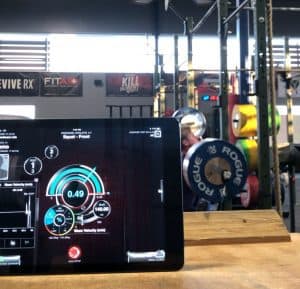 Truth be told, there are so many different factors that can impact a make or a miss in an Olympic lift that bar velocity is one of the least of my concerns. Most missed lifts occur not because the bar is too heavy but because the bar or the lifter is out of position. Let me state that again for emphasis: the bar speed of an Olympic lift means almost nothing if the lift itself is performed with gross technical errors. That said, I have the pleasure of working with some lifters who have spent years and years refining their technique in such a way that bar speed does tell us a thing or two during their pulls and their lifts.
To some degree as an athlete gets closer and closer to competition a coach has to “take off the reins” a little bit to allow for a true maximal load and maximal stimulus to become a regular part of training. They need to be used to that stimulus before they step on a platform in competition. In that regard, bar speed only gives me data but cannot be used as a measuring stick for how much weight to lift or not lift that day. However, in most competition prep blocks there are days or sessions built into a training plan at which an athlete moves between 80% and 85% for technical precision. Furthermore, these training sessions at submaximal load are designed to help the timing and the patternization of the lifts from the floor. This is especially true if they’ve been doing a large amount of work from blocks or from hang positions. During these sessions, it’s worth measuring the bar speed for a couple reasons. First, to ensure that an athlete is not getting near to maximal peak velocity. Secondly, especially with pulls and powers, to measure and monitor bar height.
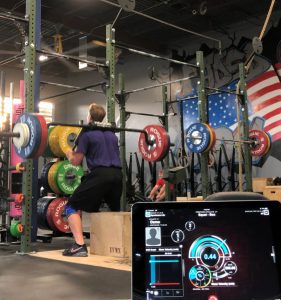 Let me give you an example. As we were prepping Jourdan for this competition, I wanted her to pull at supramaximal loads but in such a way that the bar speed was moving in a manner that would carry over to the full lifts themselves. It’s one thing to pull a really heavy load and just go through the motions. It’s another thing altogether to pull it at a speed in which the lift could be completed. Again, this takes some degree of personalization as Jourdan‘s top-end speed is far different than Shayla‘s who is far different from Jessie. Their physiological makeup and anthropomorphic‘s demand that difference. However, I know that Jourdan should be pulling a snatch at 1.75 m/s if she’s going to get the carryover necessary to her full lifts. That’s the speed she needs to move the bar during her pulls in order to create the kind of stimulus necessary for her to pull supramaximal lifts in competition. It’s one thing for me to load 100 kilos on a bar and have her pull it for 5 singles. It’s another concept altogether to make her pull all five singles above 1.75 m/s peak velocity. Furthermore, if she’s having a rough day and cannot move the bar at that speed then it’s useless for me to have her do five singles at 100kg. She would be better served by doing five singles at 90kg if it meant she was pulling at a speed that would carry over to her competition preparation.
Without the base work done on her as well as the ability to measure her speed, I likely would have missed two important pieces of data. First, I would have very little idea whether not we would be getting the stimulus we wanted from the pulls. More importantly, I would not understand what impact pulls would then have on a later more important lifting session.
I could get deep into the weeds with this one, as specific positions require different speed emphasis and different types of pulls require different speed parameters. However, truth be told, as you get closer to competition most pulling is done from the floor at full speed and with no pauses. Having baseline speed parameters for our lifts is the necessary first step. The second step is having the discipline to have an athlete pull at a lighter weight than you’d like to see in order to create the desired impact. Everybody loves to see the lifters move heavy weights. However, I’d rather see them hit competition personal records then do heavy pulls any day of the week. I think most coaches would agree to that fact.
Do your lifters a favor, and start measuring the preparatory work now that will serve them later. Start by collecting data on their pulls and their lifts in order to be more precise and more concentrated the closer you get the competition.